What FE means
| Code | What it means | Common causes | What to check |
|---|---|---|---|
| FE | Overfilling error, more water entering the tub than expected | A water inlet valve that isn't shutting off fully (stuck open or failing to seat), a clogged or kinked pressure-switch hose feeding the water-level sensor, excess suds interfering with the sensor's reading, a clogged drain filter that keeps water sitting in the tub | Shut off the supply valves if water is still entering, check the inlet valve for debris preventing it from seating, check the pressure-switch hose for a kink or clog, confirm you're not overdosing detergent |
LG's own support documentation on this code describes a few distinct paths to the same overfill reading, not just one. On front-load models, it's often tied to the drain pump activating to prevent leaks while additional water still makes its way into the drum, sometimes through the detergent dispenser. On top-load models, it points more directly to the tub filling past its expected level, and if that keeps happening after a power cycle, LG flags the water-level sensor itself as the likely fault.
Work through it in order
Stop water actively entering the tub (immediate)
If the washer is currently overfilling, shut off the hot and cold supply valves at the wall first. This solves the immediate problem regardless of what's causing it underneath, and it's a step worth taking before you troubleshoot anything else.
Check the inlet valve for debris
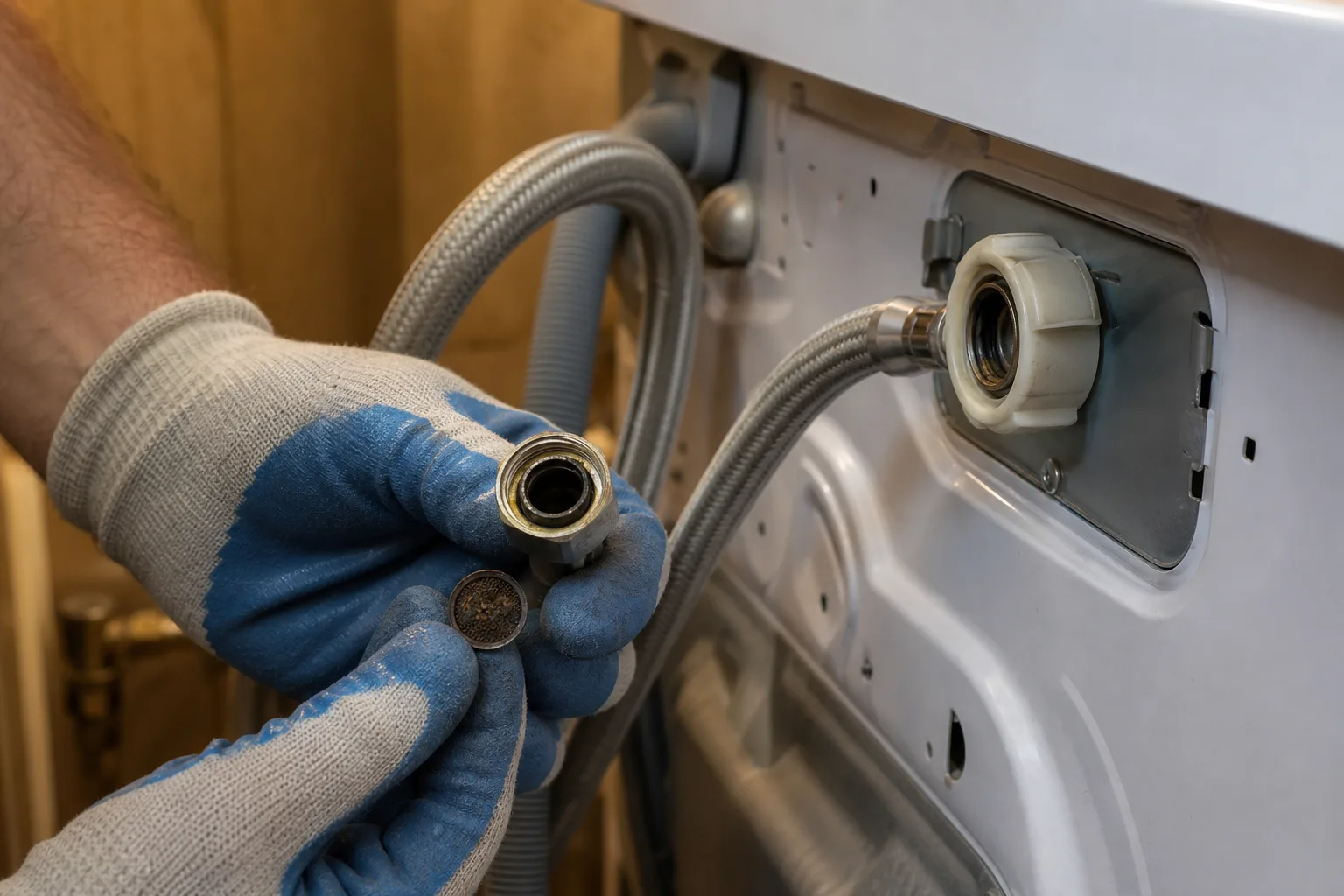
With the water off and the machine unplugged, disconnect the inlet hoses at the back of the washer and look at the valve screens and seats for grit or sediment that could be holding a valve open slightly. There are usually two valves, one for hot water and one for cold, and either can be the culprit.
Check the pressure-switch hose and rule out excessive suds
LG's documentation also connects FE to a clogged or kinked hose running to the water-level pressure switch, and separately, to excess suds confusing that same sensor. Too much detergent, or the wrong type for a high-efficiency machine, is a genuinely common trigger here, worth ruling out before assuming a mechanical part has failed.
Reconnect and run a test fill
Reconnect the hoses, restore the water supply, and run a short fill to see whether the valve shuts off correctly at the expected level. If it does, the earlier debris or suds issue was likely the whole problem.
If the valve doesn't shut off cleanly
A valve that keeps filling past the correct level even after a clean debris check and a normal detergent dose points to a failed inlet valve or a failed water-level sensor. That's a part-replacement job, not something a cleaning pass will fix.
Why FE and IE are opposite problems
IE means the washer isn't getting enough water in time, the opposite fill problem, not enough water arriving. FE means it's getting too much and the valve isn't stopping it. Both point back to the same inlet-valve system, just failing in opposite directions, which is worth knowing if you're not sure which code you actually have on your display.