Work through it in this order
Each step below takes a minute or two. Check them in sequence rather than jumping around, since the earlier ones are far more common than the later ones.
Does the opener have power?
- Check that the opener is plugged into a working outlet.
- Check the breaker for that outlet hasn't tripped.
- Look at the wall control panel inside the garage. If its light is off, the unit likely has no power at all.
Remote batteries and pairing
- Test the wall-mounted control panel directly, not the remote. If the wall button opens the door, the problem is isolated to the remote.
- Swap in fresh batteries if the remote's indicator light is dim or not lighting at all.
- If the wall button also does nothing, move to Step 3, the problem is upstream of the remote.
Safety sensors
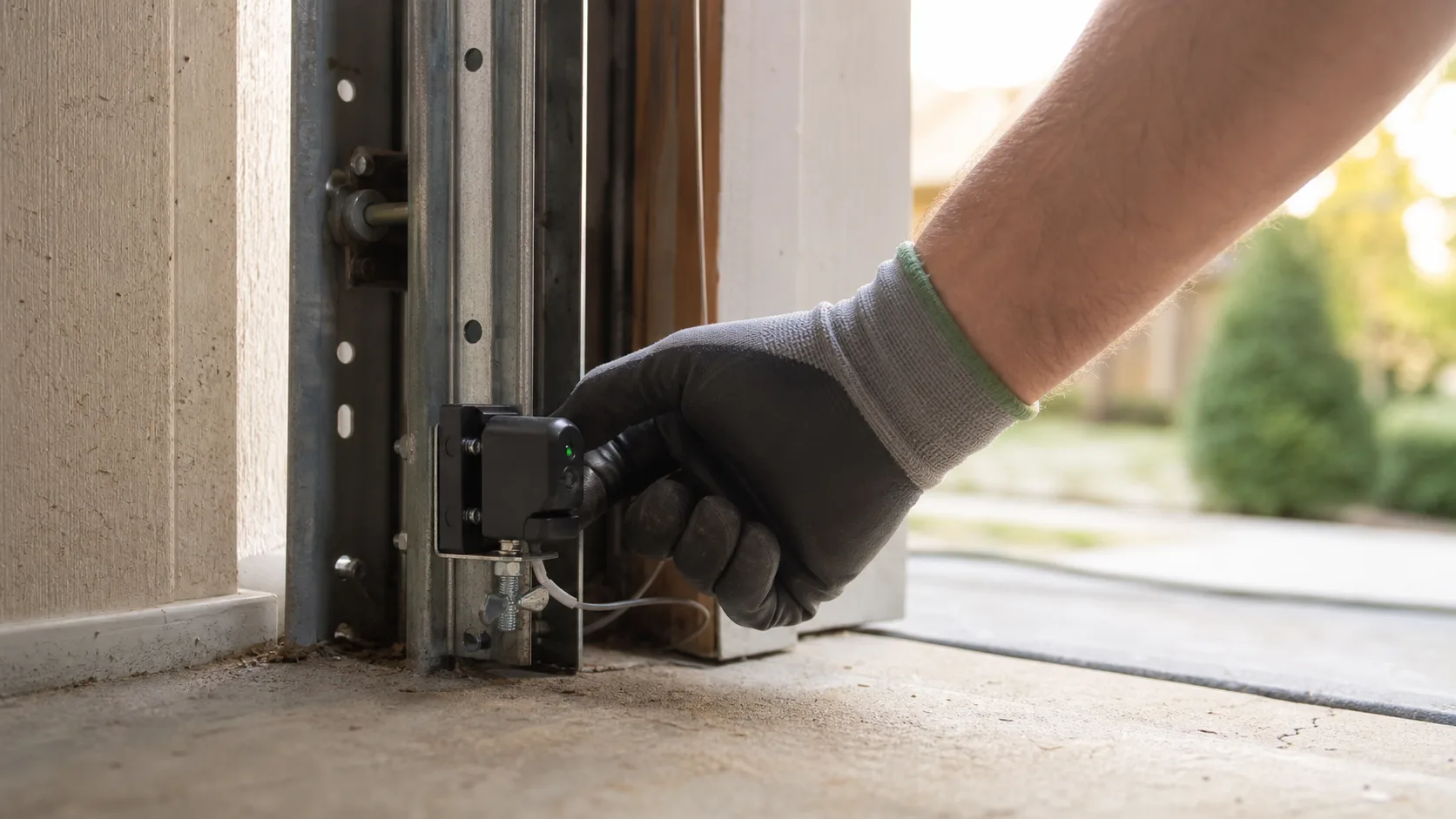
The safety sensors, sometimes called photo-eye sensors, are the two small units mounted near the floor on each side of the door track. They send an invisible beam across the doorway, and if that beam is broken, the opener refuses to close or open the door as a safety measure.
- Look at both sensors for a blinking light. A steady light usually means they're aligned; a blinking light means they aren't, or something is blocking the beam.
- Check for anything in the beam path: a leaf, a stray tool, even direct sunlight hitting one sensor can cause a false reading.
- Wipe both lenses clean and make sure the two sensors are pointed directly at each other, not at a slight angle.
Manual lock engaged
Some garage doors have a manual lock bar built into the door itself, separate from the opener. It's easy to accidentally engage after a power outage, when people sometimes lock up manually out of habit.
- Check the inside of the door near the handle for a horizontal bar or lock lever.
- If it's engaged, disengage it before testing the opener again.
Visible spring damage
If you've made it this far without finding the cause, look at the spring above the door.
- What a spring problem looks like: a visible gap in the coil, or the door feeling far heavier than normal if you try to lift it manually.
- If that's what you see, stop here. This isn't a step to work through, it's a sign to call a professional. See the guide to a spring that's visibly broken or stretched for what happens next and why it's not a DIY repair.
Opener travel limits or a motor issue
If the opener runs (you hear the motor) but the door doesn't move at all, and none of the steps above turned up a cause, the issue is likely the opener's travel limit settings or the motor itself. This is usually beyond a quick DIY fix and worth a call to a garage door technician.
If the opener works but the door won't budge
It helps to separate two different symptoms. If the opener hums or clicks but the door stays shut, the problem is mechanical: the track, a spring, or something physically jamming the door. If the opener does nothing at all, no sound, no light, the problem is electrical, and Steps 1 through 4 above are where to look first. Knowing which of these two you're dealing with saves time, since it tells you whether to keep troubleshooting the opener or start checking the door itself, including whether the door has come off its track.