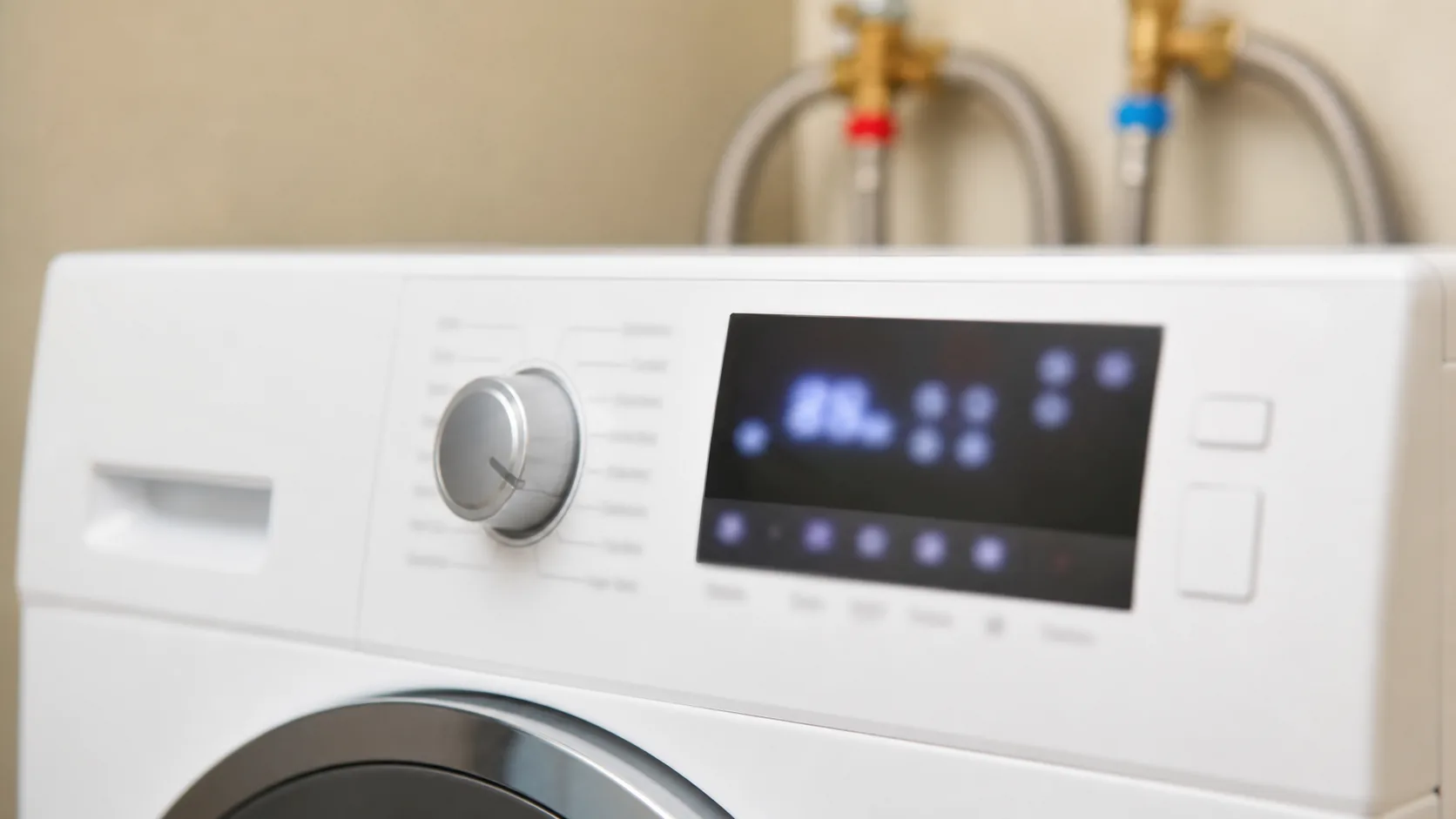
What 4E means
| Code | What it means | Common causes | What to check |
|---|---|---|---|
| 4E | Water-supply (fill) error, the washer isn't getting enough water, or fast enough. Samsung's own support content treats 4E and 4C as the same underlying fault, just displayed differently depending on the model line | Supply valve not fully open, kinked or blocked inlet hose, clogged inlet filter screen, low household water pressure, occasionally a hot-water cycle called with the hot line not actually connected | Confirm both hot and cold supply valves are fully open, check both inlet hoses for kinks, clean the inlet filter screens, test water pressure at a nearby faucet, confirm the hot line is connected if a hot cycle is running |
Samsung's own support content addresses 4E and 4C on the same troubleshooting pages rather than as two separate problems, and lists a blocked or partially closed water tap, a kinked hose, and a clogged inlet mesh filter as the leading causes (Samsung UK: the 4E error is displayed on the panel of my washing machine; Samsung US: water fill issues with Samsung washing machines).
Work through it in order
Start with the fastest check. Most 4E errors clear at step 1 or 2 without needing to touch the inlet filter at all.
Confirm both water supply valves are fully open
Check the hot and cold valves behind the washer. A valve that's only partially open is one of the most commonly overlooked causes, since it's easy to assume a valve is fully on when it's actually a quarter-turn short.
Check both inlet hoses for kinks
Look at the full length of each hose from the wall connection to the back of the washer, especially if the machine was recently moved or reinstalled. A crimped hose restricts flow enough to trigger 4E even with the valve fully open.
Clean the inlet filter screens
Turn off the water supply, disconnect the hoses at the washer end, and check the small mesh screens where each hose connects. These catch sediment from the household supply and clog more than most owners expect, especially in older homes or areas with harder water.
Test water pressure elsewhere in the house
If the valves, hoses, and filters all check out, run a nearby faucet and see whether it's slower than normal too. A house-wide low-pressure issue can trigger 4E even with nothing wrong at the washer itself.
Confirm the hot line is actually connected
If 4E shows up specifically on cycles that call for hot water, and the washer was recently installed or moved, confirm the hot-water hose is connected to an active hot line rather than capped off or swapped with cold. A washer expecting hot water it isn't receiving can trigger this exact code even when the cold-side supply is fine.
How 4E compares to 4C
Samsung doesn't treat 4E as a separate malfunction from 4C. Both describe the same water-supply shortfall, and the company's own support pages walk through the identical fix for either one: check the valves, then the hoses, then the filters, then pressure. Which letters show up on your display depends on the model and control panel generation, not on a different underlying cause. The one narrower wrinkle worth knowing is the hot-line check in step 5, since some documentation ties 4E specifically to a hot-water cycle not getting the hot supply it expects, a distinction that doesn't come up with 4C.