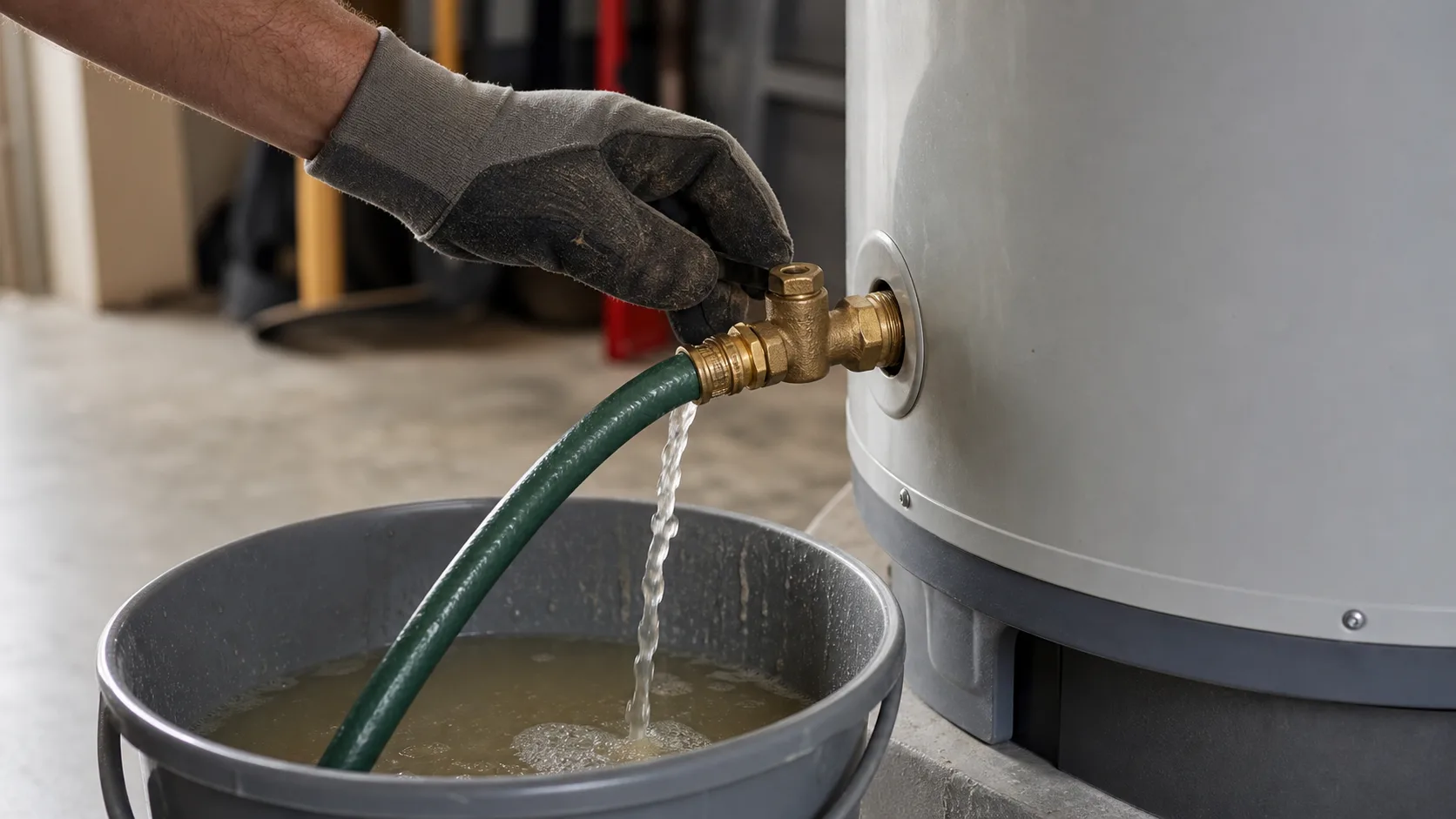
Popping or rumbling: sediment buildup
This is the most common noise complaint on a water heater. Minerals from the water supply settle at the bottom of the tank over years, and as the burner or heating element heats water through that layer, trapped pockets of water pop and rumble as they escape through the sediment.
Flushing the tank clears it. At a high level: shut off the power (electric) or the gas control (gas units) and the cold-water supply, attach a garden hose to the drain valve near the bottom of the tank, and drain and refill once or twice. Doing this roughly once a year is a common baseline recommended across manufacturer guidance, such as owner's manuals from brands like Rheem, A.O. Smith, and Bradford White, with more frequent flushing worth considering in hard-water areas. A full flush is worth doing on that kind of schedule to prevent buildup, not only after the popping has already started.
Knocking or banging in the pipes: water hammer
This is a different cause entirely, and it isn't the tank itself. A sudden knock right when a faucet shuts off, or when an appliance's water valve closes, is usually water hammer, a pressure wave moving through the pipes rather than anything wrong with the water heater. If it's persistent, a plumber can address it with an air chamber or a hammer arrestor installed near the affected fixture.
Whining or high-pitched sounds
This is usually tied to water flow through a partially closed valve or unusually high water pressure, rather than the tank itself. Check that the cold-water inlet valve feeding the unit is fully open, since a valve that's only partway open can produce a whine as water moves through the restriction.
When a noise means something more serious
- A loud bang or a hissing sound paired with any sign of leaking.
- A noise that's new and paired with reduced hot water output, which may point to a heating element or burner problem rather than sediment.
- Any noise alongside a smell of gas.